Lango (Godot 4)
Lango is an open-source top-down 2D action RPG by Delta12Studio. The player explores outdoor levels, caves and a dungeon, and fights bees, bats and a boss that damage by body contact. Its enemies run a classic state machine: IDLE, WANDER, CHASE.
This page shows Lango on the full A2G protocol 0.1: what runs today, and how the same integration uses scopes, groups, events, the decision cache and the security model.
At a glance
Section titled “At a glance”| Concern | Today | Target on full 0.1 |
|---|---|---|
| Entities | bee, bat, boss decide; player is observe-only |
Same, plus bees spawned by the boss belong to it as a group |
| Context | One world text, sent with every request | Scopes per area: outdoors, caves, dungeon, boss_arena |
| When to ask | Timer: 3 s if the player is seen, 8 s otherwise; early on a value change | Events player_spotted, hit, ally_died; refresh_ms 8000 |
| Repeated situations | Every bee asks the model | Decision cache for bees: equivalent situations share an answer |
| Oversized input | Not checked | Token budget of 700 per entity |
| Security | local profile: service on 127.0.0.1, no authentication |
local for development; client profile with join tokens, or a shipped local policy, for release |
| Reports | Matched by action | Carry decision_id |
What was changed in the game
Section titled “What was changed in the game”| File | Kind | Purpose |
|---|---|---|
a2g_manifest.json |
new | World, area scopes, entity types, events, cache rules |
A2G/A2GClient.gd |
new, SDK | The Godot SDK, autoload A2G — no Lango-specific code |
A2G/LangoA2G.gd |
new, adapter | All Lango-specific glue, autoload LangoA2G (~100 lines) |
Enemies/Enemy.gd, Bee.gd, Boss.gd |
changed | Register with A2G and ask it first; target: two notify calls for events |
project.godot |
changed | Two autoloads |
Debug/DebugOverlay.gd |
new, optional | In-game debug panel and enemy labels |
The original state machine was not removed or rewritten. A FLEE state exists only while A2G controls an enemy.
1. Manifest
Section titled “1. Manifest”Target — the manifest Lango uses on full 0.1. Fields and actions are those of the running game; scopes, groups, events, budget and cache are the additions.
{  "world": "Lango is a top-down 2D action RPG. The player fights with melee weapons or a ranged form. Hostile creatures damage the player only by body contact. The player can drink a repellent that hides them from enemies. Health is given as fractions (0..1). Distances are in pixels.",  "world_fields": { "player_hp_fraction": "number", "repellent": "boolean" },
  "scopes": {    "outdoors":   { "text": "Open outdoor levels with room to retreat and regroup." },    "caves":      { "text": "Narrow cave levels. Little room to flee; enemies meet the player at close range." },    "dungeon":    { "text": "Dungeon rooms connected by corridors." },    "boss_arena": { "parent": "dungeon", "text": "The boss room. The boss keeps spawning bees while it lives.",                    "fields": { "boss_hp_fraction": "number" } }  },
  "entity_types": {    "bee": {      "description": "Small, fragile swarm insect (3 HP). Brave in numbers; when badly wounded, alone near the player or among the last of its swarm, it keeps its distance or flees. Bees spawned by the boss follow its lead.",      "fields": {        "hp_fraction": "number", "distance_to_player": "number", "sees_player": "boolean",        "current_action": ["idle", "wander", "chase", "flee"]      },      "actions": {        "chase": "Move toward the player to hit them by contact",        "flee": "Move directly away from the player to preserve health",        "idle": "Stop and hold position",        "wander": "Patrol around the home area without engaging"      },      "events": {        "player_spotted": "The player just came into view",        "hit": "This creature was just hit by the player",        "ally_died": "A creature nearby was just killed"      },      "decision_ttl_ms": 12000,      "refresh_ms": 8000,      "perception_radius": 120,      "max_input_tokens": 700,      "cache": {        "key": ["hp_fraction", "sees_player", "current_action", "world.player_hp_fraction", "parent.action"],        "buckets": { "hp_fraction": [0.34, 0.67], "world.player_hp_fraction": [0.25, 0.5] },        "ttl_ms": 8000      }    },    "bat":  { "description": "Agile cave hunter (6 HP). Opportunistic: attacks when the player is weakened or busy with other creatures; backs off when wounded and alone.", "...": "fields, actions, events as for bee; no cache" },    "boss": { "description": "Large, tough guardian (50 HP) that keeps spawning bees. Aggressive while its bees are near the player; retreats briefly to recover when very low on health.", "...": "fields, actions, events as for bee; perception_radius 160" },    "player": {      "description": "The human-controlled hero. Not controlled by A2G.",      "fields": { "hp_fraction": "number", "action": ["move", "roll", "attack", "transition"] },      "actions": {},      "perception_radius": 80    }  }}
Why these choices:
- Scopes, not a longer world text. Areas differ in space to manoeuvre; each request carries only the active area.
- The boss as a group. Spawned bees name the boss as
parent, so they see “the boss chose to retreat” and the boss sees its brood asmembers. - Events and a slow timer. Bees far from the player stop asking every few seconds; a hit or a spotted player asks at once.
- A cache for bees only. Bees are many and alike; three health bands × visibility × current action × player health × boss intent is a few hundred situations. Bats and the boss stay individual.
2. Adapter
Section titled “2. Adapter”LangoA2G.gd is the only Lango-specific A2G code. Today:
const ACTIONS = ["idle", "wander", "chase", "flee"]  # index == enemy.state
func _ready():  A2G.world_provider = world  for type in ["bee", "bat", "boss"]:    A2G.register_adapter(type, self)  A2G.register_adapter("player", PlayerAdapter.new())  # observe-only
func world() -> Dictionary:  return {"player_hp_fraction": snappedf(Global.health / Global.max_health, 0.001), "repellent": Global.repellent}
func observe(enemy) -> Dictionary:  return {    "hp_fraction": snappedf(enemy.HEALTH / enemy.get_meta("a2g_max_health", 1.0), 0.001),    "distance_to_player": snappedf(enemy.global_position.distance_to(player.global_position), 0.1),    "sees_player": sees_player(enemy),    "current_action": ACTIONS[enemy.state],  }
# Game rule: an enemy that cannot see the player may not chase or flee.func legal_actions(enemy) -> Array:  return ACTIONS.duplicate() if sees_player(enemy) else ["idle", "wander"]
func position(enemy) -> Vector2:  return enemy.global_position
func execute(enemy, action: String, delta: float) -> bool:  if action in ["chase", "flee"] and not sees_player(enemy):    action = "idle"          # the player vanished since the decision: do something safe    executed = false         # and report the decision as blocked  # idle / wander / chase / flee reuse the enemy's own movement helpers  ...  return executed
Target additions — a few lines:
const AREAS = {"Level": "outdoors", "CaveLevel": "caves", "Dangeon": "dungeon", "Boss": "boss_arena"}
func _ready():  ...  A2G.scope_provider = area_scope   # active scope and its state, read on every decide
func area_scope() -> Dictionary:  var scene = get_tree().current_scene.name  for prefix in AREAS:    if scene.begins_with(prefix):      var state = {"boss_hp_fraction": boss_hp()} if AREAS[prefix] == "boss_arena" else {}      return {"scope": AREAS[prefix], "scope_state": state}  return {}
# Bees spawned by the boss belong to it.func parent(enemy) -> Node:  return enemy.get_meta("spawned_by", null)
3. Hooks in enemy scripts
Section titled “3. Hooks in enemy scripts”func _ready(): LangoA2G.track(self) # picks bee / bat / boss and calls A2G.track ...
func _physics_process(delta): # knockback and repellent handling stay first, unchanged ... if A2G.execute(self, delta): # A2G controls this enemy this frame return match state: # original state machine, unchanged IDLE: ...Target — events are one call where the game already reacts:
func _on_HurtBox_area_entered(area):  ...                            # existing damage code  A2G.notify(self, "hit")
func seek_player():  if playerDetectionZone.can_see_player() and not was_seeing_player:    A2G.notify(self, "player_spotted")  ...
In Boss.gd, a spawned bee gets bee.set_meta("spawned_by", self).
4. Security
Section titled “4. Security”Lango is single-player and has no game server, so its threats are simple: the player can always change their own game, and nothing they do may reach other players, the shared cache or the provider bill. See Security.
| Phase | Profile | What protects what |
|---|---|---|
| Development (today) | local |
Service bound to 127.0.0.1; the OpenAI key lives only in a2g-poc/.env; the game holds no secret |
| Release with live decisions (target) | client |
The studio backend issues a 15-minute join token per player; the service accepts only Lango’s registered manifest hash; session tokens on every request; decision_id on reports; bees’ cache entries from players stay in their own session; rate limits per player |
| Release offline (target) | none | A local policy trained on playtest decisions ships in the build; no service, no network, no key |
What Lango sends is free of personal data by construction: health fractions, distances, visibility, enum actions and positions. The player’s name is never sent. All strings are enums, so there is no free text a player could use for prompt injection.
If Lango gained online co-op, the host or a dedicated server would run the SDK in the server profile and replicate enemy behavior; clients would never call /v1/decide.
5. Messages on the wire
Section titled “5. Messages on the wire”Target shapes on full 0.1, client profile. Observations and timings are modelled on a running session; tokens, hashes and ids are illustrative and shortened.
Session — the game first gets a join token from the studio backend:
POST /v1/sessionAuthorization: Bearer eyJhbGciOiJFZERTQSJ9… ← join token: game "lango", manifest hash, pseudonymous player, exp 15 min{ "a2g": "0.1", "client_id": "48213-90412377", "game": "Lango", "engine": "Godot 4.7.2-stable (official)", "manifest": { "...": "above" } }{ "a2g": "0.1", "ok": true, "manifest_hash": "sha256:5c1e…", "session_token": "s_7Hq…", "expires_in": 3600 }Decide — in the boss room, a bee was just hit; it belongs to the boss:
POST /v1/decideAuthorization: Bearer s_7Hq…{ "client_id": "48213-90412377", "epoch": 1, "world": { "player_hp_fraction": 0.8, "repellent": false }, "scope": "boss_arena", "scope_state": { "boss_hp_fraction": 0.62 }, "entities": [ { "id": "72259471404", "type": "bee", "parent": "71005", "trigger": "hit", "observation": { "hp_fraction": 0.667, "distance_to_player": 38.2, "sees_player": true, "current_action": "chase" }, "legal_actions": ["idle", "wander", "chase", "flee"], "position": [412.5, 188.0] }, { "id": "74356623529", "type": "bee", "parent": "71005", "observation": { "hp_fraction": 1.0, "distance_to_player": 104.9, "sees_player": true, "current_action": "chase" }, "legal_actions": ["idle", "wander", "chase", "flee"] } ]}Decide response — the second bee’s situation was already answered for another bee, so it comes from the cache:
{ "a2g": "0.1", "epoch": 1, "latency_ms": 233, "decisions": [ { "id": "72259471404", "source": "AI", "action": "flee", "label": "Move directly away from the player to preserve health", "confidence": 0.64, "ttl_ms": 12000, "decision_id": "d_01J9Z4K7" }, { "id": "74356623529", "source": "AI", "action": "chase", "label": "Move toward the player to hit them by contact", "confidence": 0.7, "ttl_ms": 12000, "decision_id": "d_01J9Z4K8", "cached": true } ]}Report — when the first decision ended:
{ "client_id": "48213-90412377", "entity_id": "72259471404", "decision_id": "d_01J9Z4K7", "action": "flee", "status": "executed", "outcome": { "distance_to_player_delta": 96.4, "hp_fraction_delta": 0, "world_player_hp_fraction_delta": 0, "seconds": 4.1 }}Context — not needed for Lango’s fixed areas, which are all in the manifest. A game with generated levels would send /v1/context when one loads.
Telemetry — every second, with the active scope and each bee’s parent, so the boss sees all its brood, not only those in the current batch.
6. Debugging tools
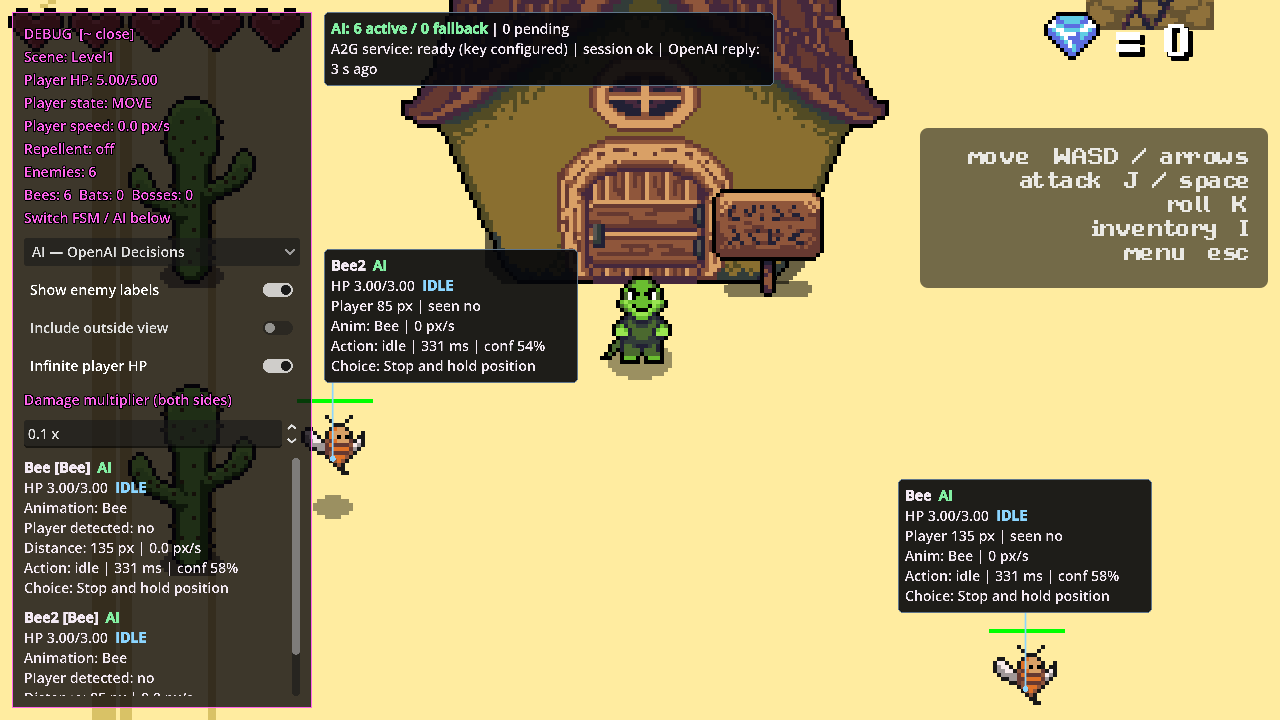
Section titled “6. Debugging tools”In-game overlay (backtick/tilde): FSM / AI switch, per-enemy cards with HP, actual state, chosen action, latency, confidence and the action description, and a banner with AI/fallback counts and the age of the last provider reply. Debug-only options: infinite player HP and a damage multiplier.
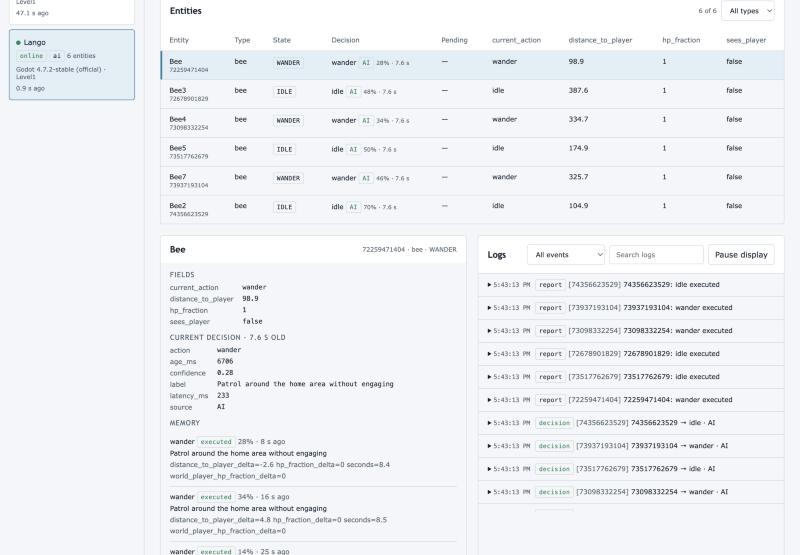
Service console at http://127.0.0.1:8787/: clients, the manifest, entities with their fields as columns, the current decision, the entity’s memory and filtered logs.
Result
Section titled “Result”Today the full core loop — manifest → batched observations → typed choice → validated action → reported outcome → memory — works in a real game, and switching back to FSM restores the original behavior.
The target version adds per-area context, boss-led groups, event-driven requests, a shared cache for bees and a release-ready security profile, without changing the game’s state machine.
Not shown yet: that AI decisions make better enemies than the original FSM, and that a second game integrates with similar effort.